Net Revenue Management (NRM) vs Revenue Growth Management (RGM): Same Discipline, Different Language
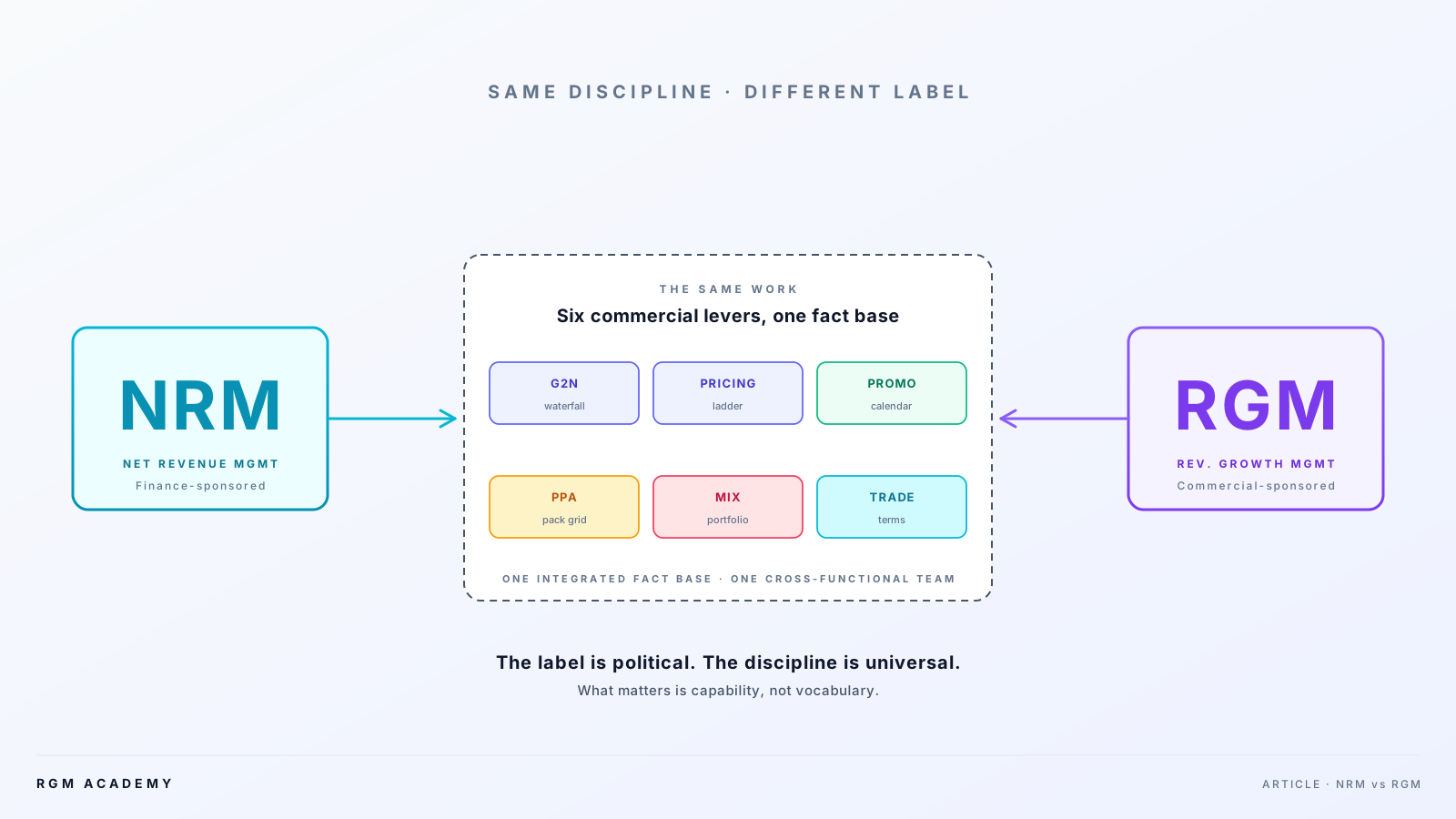
Unilever calls it NRM. Coca-Cola calls it RGM. Reckitt calls it RGMx. The labels reveal who owns the function internally — the discipline underneath is the same.
Bulent Kotan7 min read
Rich rendering temporarily unavailable — showing raw markdown.
Unilever calls it Net Revenue Management. Coca-Cola calls it Revenue Growth Management. Reckitt's partnership with McKinsey is badged **RGMx**. PepsiCo uses both terms in different geographies, often in the same week.
Ask four senior Consumer Packaged Goods (CPG) commercial leaders which label is "correct" and you'll get four slightly different answers — delivered with the confidence of a certification that doesn't exist. The reality is less tidy and more useful: the labels describe who owns the function inside a specific organization. The work underneath is the same.
## The conventional wisdom
The standard account of the difference goes roughly like this.
Net Revenue Management (NRM) is about the Gross-to-Net (G2N) waterfall. It lives in Finance. It is obsessed with trade terms, discount buckets, on-invoice and off-invoice deductions, and the gap between gross sales and net sales. A Chief Financial Officer (CFO) sponsors it. A controller builds it. A trade finance analyst runs the monthly variance review.
Revenue Growth Management (RGM) is about commercial growth levers. It lives in Sales, Marketing, or a dedicated cross-functional team. It is obsessed with Price-Pack Architecture (PPA), Trade Promotion Optimization (TPO), strategic pricing, mix, and — increasingly — Artificial Intelligence (AI). A Chief Commercial Officer (CCO) or Chief Marketing Officer (CMO) sponsors it. A commercial strategist runs it.
In the conventional telling, NRM is defensive — protect the margin, plug the leakage. RGM is offensive — grow the top line, rebalance the mix, out-price and out-innovate the competition.
<figure style="margin: 32px 0;">
<svg viewBox="0 0 760 400" xmlns="http://www.w3.org/2000/svg" style="width:100%;height:auto;font-family:Inter,system-ui,sans-serif;">
<defs>
<style>
.bg{fill:#f8fafc}.titleT{fill:#0f172a;font-size:13px;font-weight:700;letter-spacing:2px}
.subT{fill:#64748b;font-size:11px}.shared{fill:#0f172a;font-size:11px;font-weight:600}
.sliverT{fill:#475569;font-size:10px}
@media (prefers-color-scheme:dark){.bg{fill:#0f172a}.titleT{fill:#f1f5f9}.subT{fill:#94a3b8}.shared{fill:#e2e8f0}.sliverT{fill:#cbd5e1}}
</style>
</defs>
<rect class="bg" width="760" height="400" rx="10"/>
<text x="380" y="32" class="titleT" text-anchor="middle">NRM AND RGM — SAME SCOPE, DIFFERENT LABEL</text>
<text x="380" y="52" class="subT" text-anchor="middle">~90% overlap on the commercial levers that actually move profit</text>
<circle cx="300" cy="230" r="150" fill="#06B6D4" fill-opacity="0.18" stroke="#06B6D4" stroke-width="2"/>
<circle cx="460" cy="230" r="150" fill="#8B5CF6" fill-opacity="0.18" stroke="#8B5CF6" stroke-width="2"/>
<text x="205" y="110" font-size="22" font-weight="800" fill="#06B6D4" text-anchor="middle">NRM</text>
<text x="555" y="110" font-size="22" font-weight="800" fill="#8B5CF6" text-anchor="middle">RGM</text>
<text x="380" y="165" class="shared" text-anchor="middle" font-weight="700" letter-spacing="1">SHARED SCOPE (~90%)</text>
<text x="380" y="195" class="shared" text-anchor="middle">G2N waterfall</text>
<text x="380" y="214" class="shared" text-anchor="middle">Trade terms</text>
<text x="380" y="233" class="shared" text-anchor="middle">Pricing · Promotion</text>
<text x="380" y="252" class="shared" text-anchor="middle">PPA · Mix</text>
<text x="380" y="271" class="shared" text-anchor="middle">Customer planning</text>
<text x="180" y="230" class="sliverT" text-anchor="middle">variance</text>
<text x="180" y="248" class="sliverT" text-anchor="middle">compliance</text>
<text x="180" y="266" class="sliverT" text-anchor="middle">accruals</text>
<text x="580" y="230" class="sliverT" text-anchor="middle">pricing strategy</text>
<text x="580" y="248" class="sliverT" text-anchor="middle">consumer insight</text>
<text x="580" y="266" class="sliverT" text-anchor="middle">innovation</text>
<text x="380" y="380" class="subT" text-anchor="middle" font-style="italic">The difference is who sponsors it, not what it does.</text>
</svg>
<figcaption style="text-align:center;font-size:12px;color:#64748b;margin-top:8px;">Fig 1. NRM and RGM share ~90% of scope; only a thin sliver of each is distinct.</figcaption>
</figure>
It's a clean story. It's also mostly wrong.
## The evidence
Start with what the companies themselves publish.
Unilever is the global poster-child for NRM terminology. In its Q1 2025 trading update the company framed a +3% underlying sales result through a lens that covered pricing discipline, promotional intensity, mix, and portfolio actions on Power Brands — exactly the remit a Coca-Cola deck would label RGM.¹ The vocabulary was "NRM" on the slides. The scope was cross-lever.
Coca-Cola uses RGM publicly and heavily. Its Occasion-Based Portfolio Price Continuum (OBPPC) — the named framework under which pricing, pack, and channel decisions are coordinated — sits squarely inside its RGM team. But the monthly review of trade-term Return on Investment (ROI), off-invoice compliance, and customer-level G2N variance? That's in there too, under the same cross-functional umbrella.
Reckitt's partnership with McKinsey, announced publicly as **RGMx**, is marketed around "predictive pricing and profit" — but the live capability build explicitly includes G2N diagnostics, trade-term workflows, and promotional efficiency.² Label says RGM. Scope is total.
PepsiCo is perhaps the starkest example. After the Carrefour delistings of January 2024 — Doritos, Lay's, 7 Up, Lipton, and Cheetos pulled across five European countries over repeated price increases the retailer deemed unjustified — the post-mortem inside PepsiCo did not partition cleanly into "NRM issue" and "RGM issue."³ ⁴ The pricing was an RGM decision. The pass-through to net was an NRM question. The shelf consequence was both. Every serious commercial practitioner in that room was working the same problem with the same tools, under whichever flag the local organization happened to fly.
The consulting world reinforces the blur. Bain's Revenue Growth Management practice page covers G2N optimization, pricing, PPA, and promotion in a single sentence.⁵ McKinsey's RGMx / Periscope solution lists "predictive pricing and profit" as the headline capability and lumps trade-term optimization underneath.² Boston Consulting Group's (BCG) 2025 "Driving Successful Volume-Led Growth in Consumer Markets" publication treats NRM and RGM as synonymous throughout.⁶
A decade ago, the terminology probably did correlate with scope. Today the Venn diagram is a 90% overlap.
<figure style="margin: 32px 0;">
<svg viewBox="0 0 760 440" xmlns="http://www.w3.org/2000/svg" style="width:100%;height:auto;font-family:Inter,system-ui,sans-serif;">
<defs>
<style>
.bg{fill:#f8fafc}.titleT{fill:#0f172a;font-size:13px;font-weight:700;letter-spacing:2px}
.subT{fill:#64748b;font-size:11px}.hdrT{fill:#475569;font-size:11px;font-weight:700}
.rowT{fill:#0f172a;font-size:11px;font-weight:600}.dot-on{fill:#10b981}.dot-off{fill:none;stroke:#cbd5e1;stroke-width:1.5}
@media (prefers-color-scheme:dark){.bg{fill:#0f172a}.titleT{fill:#f1f5f9}.subT{fill:#94a3b8}.hdrT{fill:#cbd5e1}.rowT{fill:#e2e8f0}.dot-off{stroke:#475569}}
</style>
</defs>
<rect class="bg" width="760" height="440" rx="10"/>
<text x="380" y="30" class="titleT" text-anchor="middle">SAME SCOPE, FOUR DIFFERENT LABELS</text>
<text x="380" y="50" class="subT" text-anchor="middle">What four CPG leaders publicly cover under their respective flags</text>
<text x="30" y="90" class="hdrT">Component</text>
<text x="340" y="90" class="hdrT" text-anchor="middle">Unilever</text>
<text x="340" y="104" class="subT" text-anchor="middle">(NRM)</text>
<text x="460" y="90" class="hdrT" text-anchor="middle">Coca-Cola</text>
<text x="460" y="104" class="subT" text-anchor="middle">(RGM)</text>
<text x="580" y="90" class="hdrT" text-anchor="middle">Reckitt</text>
<text x="580" y="104" class="subT" text-anchor="middle">(RGMx)</text>
<text x="700" y="90" class="hdrT" text-anchor="middle">PepsiCo</text>
<text x="700" y="104" class="subT" text-anchor="middle">(mixed)</text>
<line x1="20" y1="118" x2="740" y2="118" stroke="#cbd5e1" stroke-width="1"/>
<g>
<text x="30" y="148" class="rowT">Gross-to-Net waterfall</text>
<circle cx="340" cy="143" r="7" class="dot-on"/><circle cx="460" cy="143" r="7" class="dot-on"/><circle cx="580" cy="143" r="7" class="dot-on"/><circle cx="700" cy="143" r="7" class="dot-on"/>
</g>
<g>
<text x="30" y="182" class="rowT">Trade terms</text>
<circle cx="340" cy="177" r="7" class="dot-on"/><circle cx="460" cy="177" r="7" class="dot-on"/><circle cx="580" cy="177" r="7" class="dot-on"/><circle cx="700" cy="177" r="7" class="dot-on"/>
</g>
<g>
<text x="30" y="216" class="rowT">Strategic pricing</text>
<circle cx="340" cy="211" r="7" class="dot-on"/><circle cx="460" cy="211" r="7" class="dot-on"/><circle cx="580" cy="211" r="7" class="dot-on"/><circle cx="700" cy="211" r="7" class="dot-on"/>
</g>
<g>
<text x="30" y="250" class="rowT">Trade promotion</text>
<circle cx="340" cy="245" r="7" class="dot-on"/><circle cx="460" cy="245" r="7" class="dot-on"/><circle cx="580" cy="245" r="7" class="dot-on"/><circle cx="700" cy="245" r="7" class="dot-on"/>
</g>
<g>
<text x="30" y="284" class="rowT">Price-Pack Architecture</text>
<circle cx="340" cy="279" r="7" class="dot-on"/><circle cx="460" cy="279" r="7" class="dot-on"/><circle cx="580" cy="279" r="7" class="dot-off"/><circle cx="700" cy="279" r="7" class="dot-on"/>
</g>
<g>
<text x="30" y="318" class="rowT">Mix & portfolio</text>
<circle cx="340" cy="313" r="7" class="dot-on"/><circle cx="460" cy="313" r="7" class="dot-on"/><circle cx="580" cy="313" r="7" class="dot-on"/><circle cx="700" cy="313" r="7" class="dot-on"/>
</g>
<g>
<text x="30" y="352" class="rowT">Customer planning</text>
<circle cx="340" cy="347" r="7" class="dot-on"/><circle cx="460" cy="347" r="7" class="dot-on"/><circle cx="580" cy="347" r="7" class="dot-on"/><circle cx="700" cy="347" r="7" class="dot-on"/>
</g>
<g>
<text x="30" y="386" class="rowT">AI-assisted decisions</text>
<circle cx="340" cy="381" r="7" class="dot-off"/><circle cx="460" cy="381" r="7" class="dot-on"/><circle cx="580" cy="381" r="7" class="dot-on"/><circle cx="700" cy="381" r="7" class="dot-on"/>
</g>
<line x1="20" y1="405" x2="740" y2="405" stroke="#cbd5e1" stroke-width="1"/>
<text x="30" y="425" class="subT"><tspan fill="#10b981" font-weight="700">●</tspan> covered under the public capability   <tspan fill="#cbd5e1">○</tspan> not publicly confirmed</text>
</svg>
<figcaption style="text-align:center;font-size:12px;color:#64748b;margin-top:8px;">Fig 2. Four companies, four labels, one underlying scope.</figcaption>
</figure>
## The nuanced resolution
So why do the labels persist, and why do practitioners argue about them?
**Organizational history matters more than framework purity.** Companies where the function was born inside Finance — typically during an inflation crisis, when CFOs went looking for unbooked margin in the G2N bridge — inherited the NRM label. Companies where the function was born inside Sales or Marketing — during a mix or innovation push — inherited the RGM label. Once the label is stuck, it's politically expensive to change.
**The sponsor signals the emphasis.** A CFO-sponsored function will prioritise leakage, compliance, and variance. A CCO-sponsored function will prioritise growth, mix, and pricing power. The underlying work is the same; the reporting cadence and the board narrative differ. You can tell within fifteen minutes of joining a review meeting which flavour you're in.
**Geography introduces its own vocabulary.** Outside the United States (US) and Western Europe, the function is often called Trade Revenue Management, Commercial Policy, Price Strategy, or simply Commercial Capability. A regional Vice President (VP) in Southeast Asia who has never used the acronym "RGM" in a conference room can be running a scope a New York-based VP would call exactly that.
What separates a high-capability operation from a low-capability one is not the label. It is three markers:
1. **An integrated view.** The G2N waterfall, pricing, promo, PPA, and mix are analysed in a single fact base, by one team, on the same cadence. Not five parallel analyses converging once a year in a budget meeting.
2. **Cross-functional authority.** The team has the mandate to move money between levers — cut promo, redirect to trade terms, fund PPA — without seeking consensus from five committees. The clearest sign is that the team carries a Profit and Loss (P&L) number of its own, not just a set of recommendations.
3. **Decision-making infrastructure.** Data, tools, and rituals. A current G2N cube that refreshes monthly. A promotional ROI system that loads in under a week. A pricing committee that meets with evidence, not opinions.
<figure style="margin: 32px 0;">
<svg viewBox="0 0 760 360" xmlns="http://www.w3.org/2000/svg" style="width:100%;height:auto;font-family:Inter,system-ui,sans-serif;">
<defs>
<style>
.bg{fill:#f8fafc}.titleT{fill:#0f172a;font-size:13px;font-weight:700;letter-spacing:2px}
.subT{fill:#64748b;font-size:11px}.markerT{fill:#0f172a;font-size:13px;font-weight:700}
.descT{fill:#475569;font-size:10px}.trackBg{fill:#e2e8f0}
@media (prefers-color-scheme:dark){.bg{fill:#0f172a}.titleT{fill:#f1f5f9}.subT{fill:#94a3b8}.markerT{fill:#f1f5f9}.descT{fill:#cbd5e1}.trackBg{fill:#334155}}
</style>
</defs>
<rect class="bg" width="760" height="360" rx="10"/>
<text x="380" y="30" class="titleT" text-anchor="middle">CAPABILITY — THE ONLY THING THAT MATTERS</text>
<text x="380" y="50" class="subT" text-anchor="middle">How most organisations actually score on the three markers</text>
<g transform="translate(40 90)">
<text x="0" y="0" class="markerT">1. Integrated view</text>
<text x="0" y="18" class="descT">One fact base. One team. One cadence.</text>
<rect x="360" y="-14" width="320" height="16" rx="8" class="trackBg"/>
<rect x="360" y="-14" width="128" height="16" rx="8" fill="#F59E0B"/>
<text x="500" y="-2" font-size="11" font-weight="700" fill="#92400e">WEAK PASS · 40%</text>
</g>
<g transform="translate(40 170)">
<text x="0" y="0" class="markerT">2. Cross-functional authority</text>
<text x="0" y="18" class="descT">The team carries its own P&L, not just a set of recommendations.</text>
<rect x="360" y="-14" width="320" height="16" rx="8" class="trackBg"/>
<rect x="360" y="-14" width="192" height="16" rx="8" fill="#10B981"/>
<text x="500" y="-2" font-size="11" font-weight="700" fill="#065f46">MEDIUM · 60%</text>
</g>
<g transform="translate(40 250)">
<text x="0" y="0" class="markerT">3. Decision infrastructure</text>
<text x="0" y="18" class="descT">G2N cube refreshed monthly. Promo ROI loads in under a week.</text>
<rect x="360" y="-14" width="320" height="16" rx="8" class="trackBg"/>
<rect x="360" y="-14" width="80" height="16" rx="8" fill="#F43F5E"/>
<text x="500" y="-2" font-size="11" font-weight="700" fill="#9f1239">FAIL · 25%</text>
</g>
<text x="380" y="330" class="subT" text-anchor="middle" font-style="italic">The next move is not a rebrand. It is to close the gap on the weakest marker.</text>
</svg>
<figcaption style="text-align:center;font-size:12px;color:#64748b;margin-top:8px;">Fig 3. The three capability markers. Infrastructure is where almost every organisation fails hardest.</figcaption>
</figure>
The article [What Is Revenue Growth Management? The Six-Lever Framework](/blog/what-is-rgm-six-lever-framework) walks the six commercial levers in detail. The distinction that matters is not whether you call the function NRM or RGM — it is whether you can tick all three capability markers honestly.
## What this means for your work
Stop arguing the label. If your CFO prefers NRM, call it NRM. If your CCO prefers RGM, call it RGM. Bain's finding that roughly 75% of RGM programmes fail and that only 5% of CPGs truly get it right applies equally to NRM programmes by any name.⁵ None of those failures are because the team used the wrong acronym.
Instead, audit the capability. Put your function against the three markers above and score it honestly. Most organisations get a weak pass on integration, a medium on authority, and fail hard on infrastructure. The next move is not a rebrand. It is to close the gap on the weakest marker.
And do one more thing: watch for the day a senior leader from a different label walks in. A Unilever veteran who joins a Coca-Cola commercial team is not learning a new discipline. They are learning new vocabulary for old work. The faster the organisation can strip the vocabulary and compare the underlying capability on its merits, the faster the function stops being a naming debate and starts being a source of operating profit.
That transition is also how the broader pricing-to-volume reset of 2026 plays out internally. The [Great RGM Reset](/blog/great-rgm-reset-price-to-volume) is, at its core, a capability story in disguise. The companies that came through the 2022–2024 price era with labels but no real muscle are the ones getting exposed now.
## References
1. Unilever Q1 2025 Trading Update commentary — Fortune, 24 April 2025: https://fortune.com/europe/2025/04/24/price-hikes-unilever-nestle-tariffs/
2. Reckitt–McKinsey RGMx partnership — McKinsey Periscope: https://www.mckinsey.com/capabilities/growth-marketing-and-sales/solutions/periscope/solutions/revenue-growth-management
3. PepsiCo / Carrefour delistings, January 2024 — Fortune: https://fortune.com/europe/2024/01/04/shrinkflation-pepsico-price-increases-carrefour-french-supermarket-pulls-snacks/
4. Carrefour PepsiCo coverage — CNBC, 5 January 2024: https://www.cnbc.com/2024/01/05/some-carrefour-stores-in-europe-pull-pepsico-products-over-price-hikes.html
5. Bain & Company — Revenue Growth Management practice (75% failure, 5% success, 70% SKU concentration stats): https://www.bain.com/industry-expertise/consumer-products/revenue-growth-management/
6. BCG "Driving Successful Volume-Led Growth in Consumer Markets," 2025: https://www.bcg.com/publications/2025/driving-volume-led-growth-in-consumer-markets
---
## 📚 Learn more on RGM Academy
Take these concepts deeper with lessons from [RGM Academy](https://rgmacademy.app):
- **Gross-to-Net (G2N) Waterfall** — The foundational diagnostic every NRM and RGM function depends on: how gross revenue becomes net revenue across on-invoice and off-invoice deductions. *Why this matters for this article: the G2N waterfall is the single piece of shared scaffolding every serious NRM/RGM capability is built around, regardless of label.*
→ [Start the lesson](https://rgmacademy.app/integration/1-g2n)
- **Anatomy of Trade Terms** — The structure, logic, and negotiation calculus of customer terms — the piece of the P&L most likely to sit under an NRM label. *Why this matters for this article: trade terms are where NRM and RGM most obviously overlap; mastering the anatomy is step zero for either.*
→ [Start the lesson](https://rgmacademy.app/trade-terms/1-anatomy)
- **Cross-Lever Integration** — How the six commercial levers interact, where the hand-offs break, and which combinations move operating profit the most. *Why this matters for this article: the capability markers in this article — integrated view, cross-functional authority, decision infrastructure — come alive in a cross-lever simulator.*
→ [Start the lesson](https://rgmacademy.app/integration/6-cross-lever)